Free delivery and training on selected products
 Discounts for collection in person
 Expert advice
 Support from our physical stores








Ceramic studio from A to Z
Dear customers, fellow potters, ladies and gentlemen,
We are delighted to see our customer base growing, particularly with enthusiasts who have tried working with clay but do not yet have the facilities to finish their work. Anyone captivated by ceramics who wants to continue knows how difficult it is to produce finished pieces without a kiln. We understand that the equipment and materials on offer can be confusing, so we have come up with a solution.
Would you like to start pottery at home, at school or in a practice? You are in the right place. Let us help you choose equipment and keep the plan modest. A beautiful pottery studio can be set up on a small budget.
Mistakes in choosing equipment are expensive. It is frustrating to discover later that unused tools take up space, an oversized kiln dwarfs your small pieces, nobody has used the wheel and the slab roller gathers dust, despite the money spent. Sadly, grant-funded projects sometimes end this way.
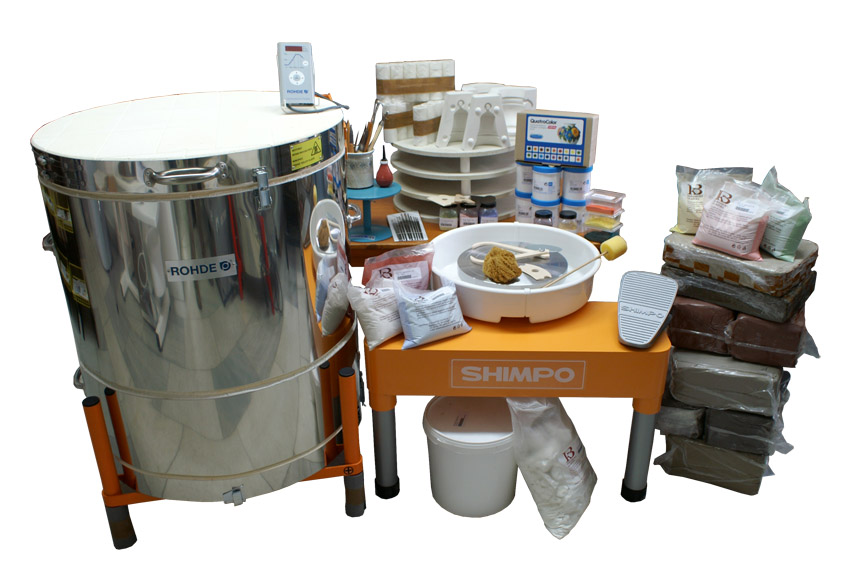
A fully functional pottery workshop can be affordable. Our special START offer contains everything needed. The high-quality kiln allows high-temperature firing. Each accessory serves a purpose, so your new studio will not be cluttered with unnecessary items.
The foundation is a Kittec CB 40 ceramic kiln with a 230 V connection, a very capable controller and kiln furniture.
This kiln handles daily use and easily fires stoneware and some porcelains. It has the same power and internal diameter, and therefore shelf size, as common 60-litre models, making it fast and tireless. It is around 7 cm lower than 50-litre models, but are you sure you will use more than 30 cm of internal height?
The clays, glazes and engobes supplied with the kiln share a compatible firing range, and we include the most important tools and equipment.
You get everything needed to start creating and save money too. For a favourable price, you receive a studio with nothing essential missing. Delivery within the Czech Republic and documented operator training are included. The Kittec CB 40 kiln comes with an extended four-year warranty.
START set – KITTEC CB 40 top-loading ceramic kiln with TC 44 +materials and tools
.........................................................................................................................................
Further suggestions for equipping a pottery studio
We will follow each stage of making ceramics, from soft clay to a durable fired body. At each step, we will consider what is needed next and gradually equip our workshop logically. With care, we will return to tools that have proved effective, decorate with the most suitable materials and fire in the ideal kiln.
Ceramic clays are classified by their intended use as
Choose tools to suit your chosen technique.
- For wheel throwing, you will need ribs, blades, hole-making tools, scrapers and cutting wire
- For handbuilding, prepare hole cutters, needles, knives, loop tools and modelling tools
- For slip casting, you need the appropriate plaster mould
A clay pugmill makes processing and preparing clay easier and more convenient. It also helps in sheltered workshops employing people with disabilities. Some pugmills have a vacuum system that removes almost all excess air from the clay.
Potter's wheels are a subject covered in more detail in our catalogue. They can make pottery enjoyable or thoroughly frustrating. Throwing can be physically demanding and takes considerable practice to learn. Once mastered, it adds an entirely new dimension to a studio. That is why choosing the right wheel matters so much.
Broadly, potter's wheels are divided into
- electric wheels and kick wheels
- tabletop and freestanding models
- domestic and imported models
Another machine encountered on our journey through ceramic techniques is the slab roller. It takes over where a wooden rolling pin is insufficient for preparing slabs. Anyone whose back aches during modelling, or who incises leather-hard clay, also needs a banding wheel.
This guide mainly assumes a two-firing process. Single-firing methods also exist, in which the piece is finished in one firing. A suitable decorating material for single firing is ceramic engobe. Engobes are coloured clay slips applied to unfired, leather-hard clay. Some, with a higher flux and pigment content, also adhere when applied to bisque-fired ware. Ceramic engobe is suitable for sgraffito, where a needle reveals the clay colour underneath. Engobe can be decorated further. A transparent glaze improves the functional qualities of engobed ware and brightens the colours
After air drying, the first firing takes place in a ceramic kiln.
- The shape, quantity and size of the pieces determine the kiln dimensions and loading method. Top-loaders are loaded from above; chamber kilns from the front.
- Depending on our technical and financial resources, we then choose between a 230 V kiln, up to 60 litres, and a 400 V kiln.
- The intended use of our pieces determines the required maximum firing temperature, a fundamental quality criterion for every kiln. We distinguish lower-temperature earthenware kilns from those capable of firing very hard stoneware. Workshop operation also matters: how many firings, and at what temperatures, are planned over a given period? The overall kiln setup is crucial to economical production and to the properties, quantity and size of the pieces. When planning a studio, we often suggest considering a separate bisque kiln and a glaze-firing kiln.
Bisque-fired ware is a porous blank ready to receive decoration. We decorate it with colours or apply glaze directly.
Ceramic KD decorating colours are used beneath a transparent glaze. They also work well for majolica: painting into unfired glaze.
Before working with ceramic glazes, let us divide them into categories:
- by firing temperature: roughly earthenware (1000–1150°C) and stoneware (above 1200°C)
- by surface finish: glossy, matt and effect glazes
- by opacity: transparent, semi-opaque (semi-transparent) and opaque
Suggestions for fully equipped workshops
- for beginners, hobby potters or small school studios
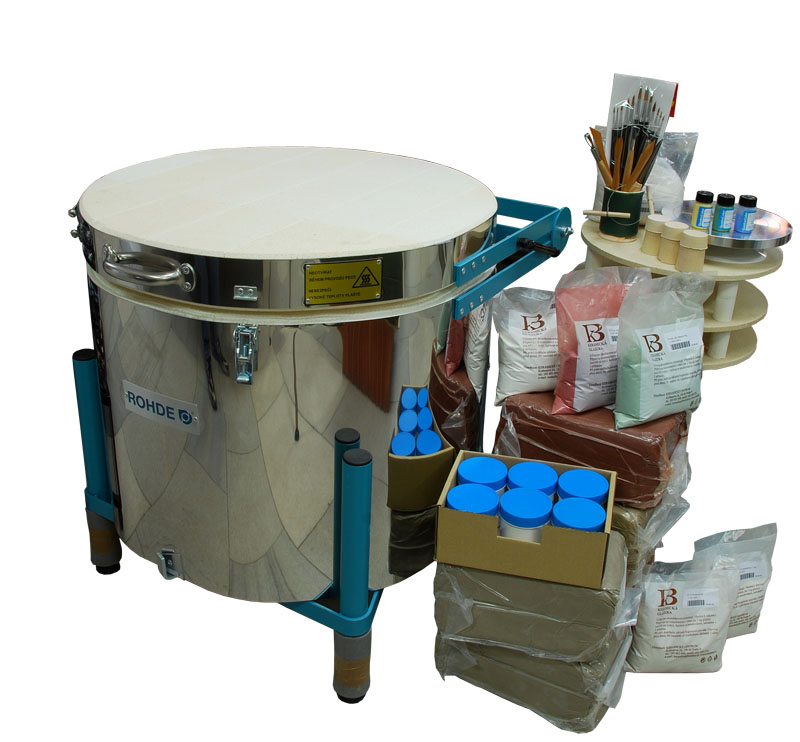
- for functional ceramics production, an artist's studio or a generously equipped school studio